Automation is no longer just a tool for operational efficiency. In 2026, the real competitive advantage will not come from automating more tasks, but from embedding intelligence into processes to improve decision-making, responsiveness, and adaptability.
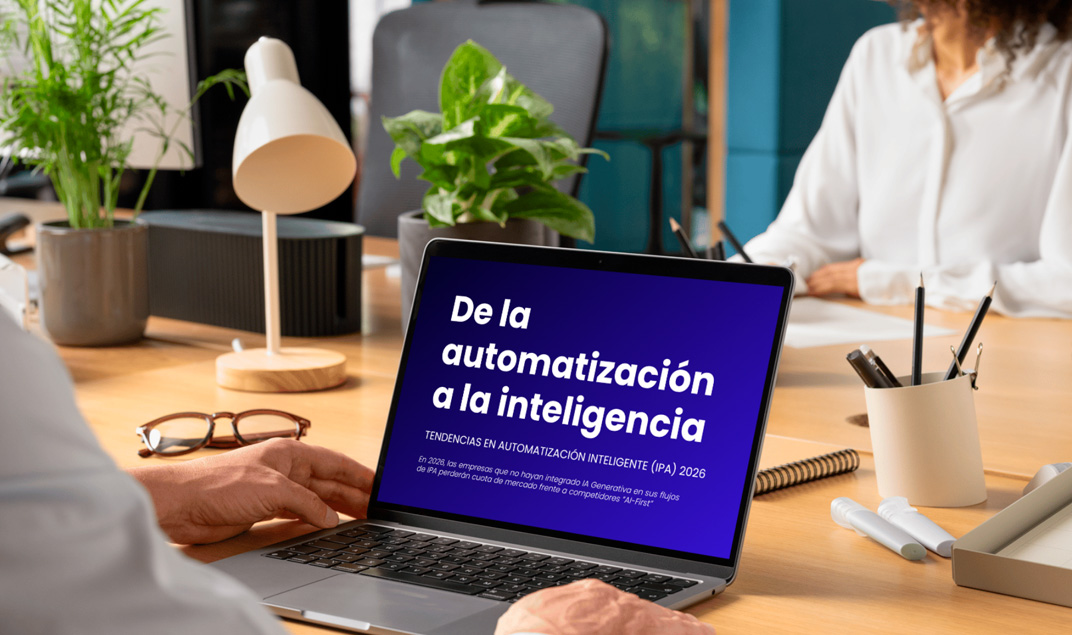
That shift is the core insight of Ecosistemas Global’s new trend report, From Automation to Intelligence, which examines how Intelligent Process Automation (IPA) is evolving across Latin America, Spain, and the United States. The conclusion is clear: organizations that fail to integrate generative AI into their automation flows risk losing competitiveness against more agile, connected, and business-oriented models.
From repetitive execution to operational intelligence
For years, traditional automation—especially through RPA—helped organizations optimize repetitive tasks, reduce errors, and improve efficiency in structured processes. But that model is no longer enough to respond to more complex operations, more demanding customers, and environments that require real-time decisions.
The new stage is defined by Intelligent Process Automation (IPA), an evolution that combines automation, advanced analytics, and artificial intelligence to support not only execution, but also interpretation, prioritization, and decision-making.
In this context, automation is no longer just about doing the same work faster. It is becoming a strategic capability for redesigning critical processes and generating measurable business impact.
Generative AI is accelerating the shift
One of the strongest accelerators behind this transformation is the rise of generative AI. Its impact goes far beyond improving interfaces or producing content: it is expanding automation into processes that previously required constant human intervention.
Document analysis, customer service, operational support, response generation, and unstructured data processing are just some of the areas where generative AI is already pushing IPA into new territory.
This means automation is moving beyond structured workflows and beginning to operate in more dynamic environments, with greater context, learning capacity, and adaptability.
The gap is not adoption, but maturity
Today, the main challenge is not simply adopting technology, but turning adoption into real impact. Many organizations are already implementing AI and automation tools, yet still struggle to connect them with business processes, legacy systems, performance metrics, and long-term strategy.
That gap between intention and execution becomes especially visible when inefficient processes are automated without prior redesign or a broader operational vision. In those cases, technology does not solve the root problem—it merely scales it.
That is why one of the report’s key conclusions is that the real risk is no longer failing to automate, but automating without strategy.
A regional landscape full of opportunities and challenges
The landscape is uneven. Latin America is showing strong acceleration in adoption, although structural limitations still affect scalability. Brazil leads regional maturity, Chile is advancing in a more structured way, Mexico is accelerating thanks to nearshoring, and Argentina remains focused on efficiency, with room to evolve.
Spain, meanwhile, continues to strengthen enterprise AI adoption as part of the broader European digital transformation process.
In every case, the opportunity is the same: closing the gap between technology usage and business impact.
What leading organizations do differently
Organizations that are achieving concrete results with intelligent automation tend to share several characteristics: they automate end-to-end processes, integrate AI, data, and automation into a unified approach, measure business impact, and align technology with strategic priorities.
In other words, they do not treat automation as an isolated technical initiative, but as an organizational capability that cuts across functions.
That is the central point: competitive advantage will not come from who adopts the most tools, but from who implements them with better judgment, stronger integration, and a clearer focus on outcomes.
From tech trend to structural business condition
Intelligent automation is no longer a future promise. It is redefining how organizations operate, scale, and compete. In that context, the question is no longer whether automation matters. The real question is how to implement it in a way that is intelligent, sustainable, and aligned with business priorities.
Because in the next stage of digital transformation, the difference will not be who automates more, but who turns automation into intelligence applied to operations.
From Automation to Intelligence and explore the key IPA trends shaping 2026.
Share
Automation is no longer just a tool for operational efficiency. In 2026, the real competitive advantage will not come from automating more tasks, but from embedding intelligence into processes to improve decision-making, responsiveness, and adaptability.
That shift is the core insight of Ecosistemas Global’s new trend report, From Automation to Intelligence, which examines how Intelligent Process Automation (IPA) is evolving across Latin America, Spain, and the United States. The conclusion is clear: organizations that fail to integrate generative AI into their automation flows risk losing competitiveness against more agile, connected, and business-oriented models.
From repetitive execution to operational intelligence
For years, traditional automation—especially through RPA—helped organizations optimize repetitive tasks, reduce errors, and improve efficiency in structured processes. But that model is no longer enough to respond to more complex operations, more demanding customers, and environments that require real-time decisions.
The new stage is defined by Intelligent Process Automation (IPA), an evolution that combines automation, advanced analytics, and artificial intelligence to support not only execution, but also interpretation, prioritization, and decision-making.
In this context, automation is no longer just about doing the same work faster. It is becoming a strategic capability for redesigning critical processes and generating measurable business impact.
Generative AI is accelerating the shift
One of the strongest accelerators behind this transformation is the rise of generative AI. Its impact goes far beyond improving interfaces or producing content: it is expanding automation into processes that previously required constant human intervention.
Document analysis, customer service, operational support, response generation, and unstructured data processing are just some of the areas where generative AI is already pushing IPA into new territory.
This means automation is moving beyond structured workflows and beginning to operate in more dynamic environments, with greater context, learning capacity, and adaptability.
The gap is not adoption, but maturity
Today, the main challenge is not simply adopting technology, but turning adoption into real impact. Many organizations are already implementing AI and automation tools, yet still struggle to connect them with business processes, legacy systems, performance metrics, and long-term strategy.
That gap between intention and execution becomes especially visible when inefficient processes are automated without prior redesign or a broader operational vision. In those cases, technology does not solve the root problem—it merely scales it.
That is why one of the report’s key conclusions is that the real risk is no longer failing to automate, but automating without strategy.
A regional landscape full of opportunities and challenges
The landscape is uneven. Latin America is showing strong acceleration in adoption, although structural limitations still affect scalability. Brazil leads regional maturity, Chile is advancing in a more structured way, Mexico is accelerating thanks to nearshoring, and Argentina remains focused on efficiency, with room to evolve.
Spain, meanwhile, continues to strengthen enterprise AI adoption as part of the broader European digital transformation process.
In every case, the opportunity is the same: closing the gap between technology usage and business impact.
What leading organizations do differently
Organizations that are achieving concrete results with intelligent automation tend to share several characteristics: they automate end-to-end processes, integrate AI, data, and automation into a unified approach, measure business impact, and align technology with strategic priorities.
In other words, they do not treat automation as an isolated technical initiative, but as an organizational capability that cuts across functions.
That is the central point: competitive advantage will not come from who adopts the most tools, but from who implements them with better judgment, stronger integration, and a clearer focus on outcomes.
From tech trend to structural business condition
Intelligent automation is no longer a future promise. It is redefining how organizations operate, scale, and compete. In that context, the question is no longer whether automation matters. The real question is how to implement it in a way that is intelligent, sustainable, and aligned with business priorities.
Because in the next stage of digital transformation, the difference will not be who automates more, but who turns automation into intelligence applied to operations.
From Automation to Intelligence and explore the key IPA trends shaping 2026.